From Pultec to Plugin Recall: A Short History of the Passive Equalizer
Key takeaways
- A passive equalizer shapes sound using only inductors, capacitors and resistors, then restores the lost level with a make-up amplifier.
- The Pultec EQP-1, introduced by Pulse Techniques in 1951, defined the passive EQ sound that engineers still chase today.
- In 2011 Bettermaker introduced the EQ232P, which we believe was the first passive-style studio equalizer with full digital recall of every setting.
- Bettermaker Stereo Passive Equalizer, VSPE and PQ_core continue that line: a 100% analog passive signal path controlled, automated and recalled from a DAW plugin.
What is a passive equalizer?
A passive equalizer is an EQ whose filter network contains no amplifying components. The tone shaping happens in a network of inductors (L), capacitors (C) and resistors (R). Because a passive network can only remove energy, it cuts the overall level of the signal, often by around 16 to 20 dB. A separate make-up gain stage, built with vacuum tubes in the classic designs, brings the signal back to line level.
This architecture is why passive EQs sound the way they do. The curves are broad and gentle, phase shift is smooth, and the make-up amplifier and transformers add their own subtle weight. Engineers often describe the result as "musical": you can boost generously without the harshness of many active designs.
1951: Pulse Techniques and the Pultec EQP-1
The story of the passive EQ in the modern studio starts in Teaneck, New Jersey. In 1951 Pulse Techniques, founded by Ollie Summerland and Gene Shenk, released the Pultec EQP-1 program equalizer. Its layout was deceptively simple: a low-frequency section with separate boost and attenuation controls, a high-frequency boost with a variable bandwidth control, and a high-frequency attenuation shelf.
The improved EQP-1A became the version most engineers know. Pulse Techniques later expanded the family with midrange models such as the MEQ-5. For decades, Pultecs sat in the racks of the most important studios in the world, on vocals, drums, bass and the mix bus alike.
The famous Pultec low-end trick
The detail that made the Pultec legendary was almost accidental. Its low-frequency boost and attenuation controls work at the same selected frequency but are not exact mirror images. Engage both at once and they do not cancel out. Instead you get a resonant boost at the chosen frequency with a gentle dip just above it.
The result is a low end that feels bigger and tighter at the same time: more weight, less mud. This "Pultec trick" became one of the most copied moves in audio engineering, and it is the reason so many modern passive EQs keep separate boost and cut controls on the low shelf.
After Pultec: the passive EQ becomes a category
Original Pultec production ended in the early 1980s, but demand never went away. Vintage units became expensive and scarce, and other manufacturers stepped in:
- Tube-Tech (Denmark) launched the PE 1 series in the mid-1980s, bringing Pultec-style passive EQ back into production with modern build quality.
- Manley Laboratories introduced the Massive Passive in 1998, a four-band stereo tube EQ that expanded the passive concept into a full mastering tool.
- Software emulations arrived in the 2000s, led by licensed plugin versions of the EQP-1A, which brought the curves into every DAW.
- Affordable hardware reissues from brands such as Warm Audio and Klark Teknik made Pultec-style EQ accessible to home and project studios in the 2010s.
- Pulse Techniques itself was revived in the late 2010s, returning the EQP-1A to production.
Every one of these hardware designs, however, shared the limitation of the original: settings lived on the front panel and nowhere else. Coming back to a mix meant photos, notes and careful re-tweaking by ear.
2011: Bettermaker EQ232P, the first passive EQ with recall
Bettermaker was founded in Warsaw in 2011 by sound engineer and producer Marek "Maro" Walaszek with a simple question: why should analog sound mean giving up the speed of a digital workflow?
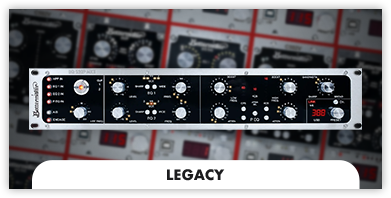
The answer was the Bettermaker EQ232P, introduced in 2011. It combined a Pultec-style, inductor-based passive section with a high-pass filter and two parametric bands, all in a 100% analog signal path. What made it different was control. Every parameter was digitally controlled, and the unit could store and instantly recall complete settings. To our knowledge, it was the first passive-style studio equalizer with full digital recall.
In 2013 Bettermaker took the next step with the EQ232P Remote and DAW plugin integration. The hardware could now be controlled, automated and recalled directly from the session. The later EQ232P MKII refined the design with more than 30 improvements and memory for 399 user presets.
Bettermaker SPE: a pure passive EQ, recalled like a plugin
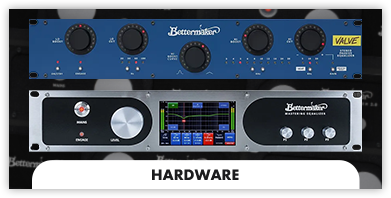
The Bettermaker Stereo Passive Equalizer (SPE) distills the idea to its essence: a 100% analog signal path of classic passive filters, precisely matched inductors and capacitors, and a mastering-grade make-up stage. All control happens in the digital domain through Bettermaker's patented Session Recall technology, so the SPE opens with your session and recalls with the speed of a native plugin.
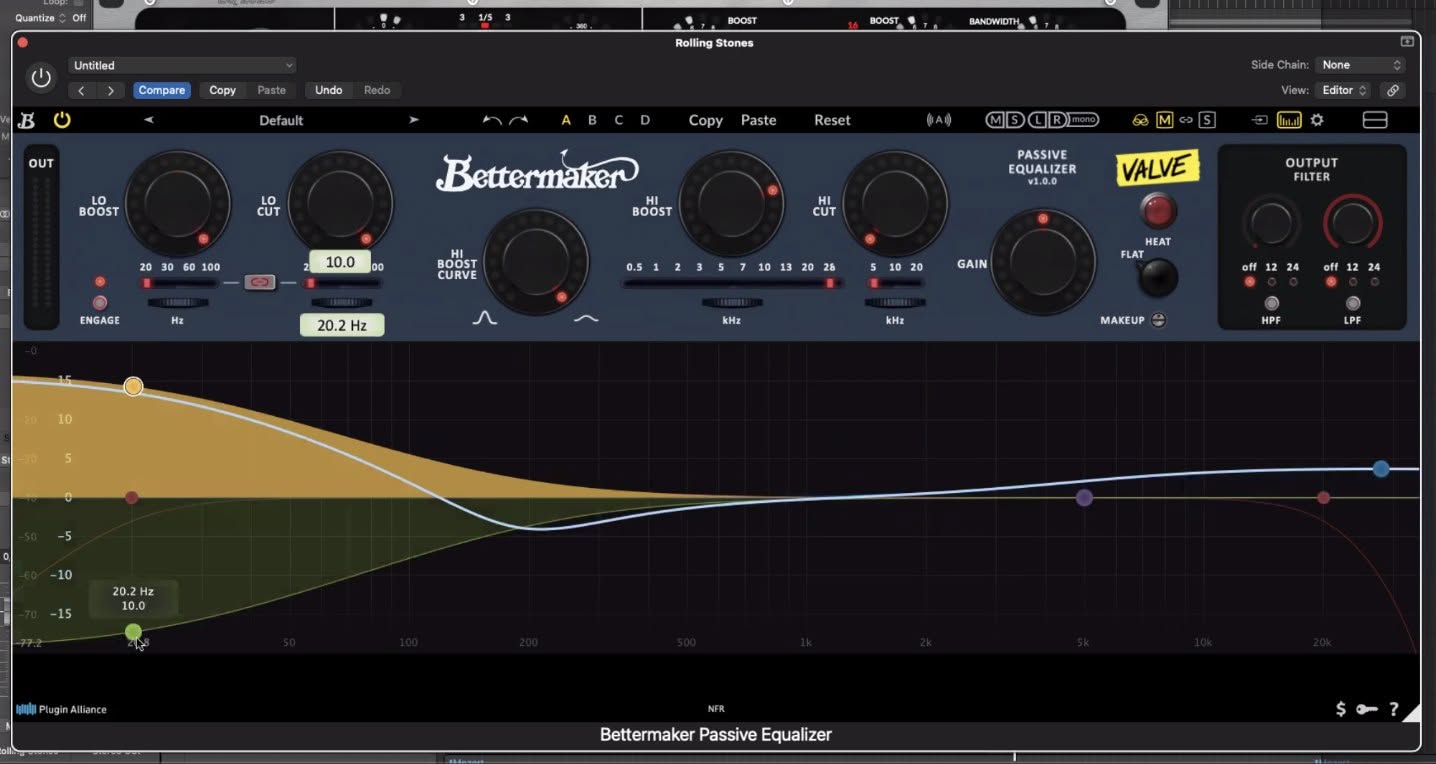
The new-generation SPE plugin (VST3, AU, AAX) adds features no vintage passive EQ could offer: an extended high boost with 20 kHz and 28 kHz air bands, a digital low-pass filter, THD saturation, an interactive curve graph with draggable handles, band auditioning, quantized controls and a new preset manager.
Bettermaker VSPE: vacuum tubes and handcrafted transformers
Launched in 2024, the Bettermaker Valve Stereo Passive Equalizer (VSPE) returns to the tube heritage of the original Pultec. It uses NOS military-grade vacuum tubes in the drive stage, hand-matched inductors and Bettermaker's own TT-1 audio transformers, developed and wound in Poland after years of research into low-frequency coherence and distortion.
A HEAT switch drives the tubes harder for extra saturation while keeping the overall gain constant. The hybrid DAW plugin recalls every setting, including HEAT, and adds digital HPF and LPF, a spectrum analyzer, session snapshots, dual-mono operation and auto audition of the selected band.
Bettermaker PEQ_core: the passive EQ built for the DAW
The newest member of the family, PEQ_core (2026), brings the mastering-grade sound of the SPE into a compact 1U chassis. It has no front-panel knobs at all. Every parameter lives in the VST3, AU and AAX plugin, which means the budget goes into the analog circuit instead of pots, displays and metalwork.
The result is a 100% analog passive EQ with instant recall, full automation and the extended 20 kHz and 28 kHz air bands, at a price of 999 EUR. For hybrid mixing and mastering studios, it is the most direct route to real passive EQ in a modern session.
Why plugin recall matters for passive EQ
Passive EQ settings are subtle. A half step on the low boost or a slight change in bandwidth transforms a mix, which is exactly why the settings are so hard to reproduce by hand. Plugin recall solves the problem at its root:
- Instant revisions: reopen a session and the hardware returns to exactly where you left it.
- Automation: passive EQ moves can be written and played back like any plugin parameter.
- Precision: stepped and quantized controls, curve graphs and band audition make fine decisions faster.
- Consistency: the same curve on every stem, every version and every client revision.
Seventy-five years after the first Pultec, the sound of passive EQ has not changed much. What has changed is how you work with it. Bettermaker has been building that bridge since 2011.
FAQ
Who invented the passive equalizer used in studios?The Pultec EQP-1, introduced in 1951 by Pulse Techniques (Ollie Summerland and Gene Shenk), established the passive program equalizer as a studio standard.
What is the Pultec low-end trick?Boosting and attenuating the same low frequency at the same time. Because the two curves differ, the result is a resonant bass boost with a small dip above it, giving weight without mud.
Why do passive EQs need a make-up amplifier?A passive filter network contains no amplifying parts and loses signal level. A make-up gain stage, traditionally tube-based, restores it to line level and adds its own character.
What was the first passive EQ with digital recall?The Bettermaker EQ232P, introduced in 2011, combined a Pultec-style passive section with full digital recall of all settings.
What is the difference between Bettermaker SPE, VSPE and PEQ_core?All three are 100% analog stereo passive EQs with DAW plugin recall. The Stereo Passive Equalizer is the flagship with hardware controls, the Valve Stereo Passive Equalizer adds vacuum tubes and Bettermaker TT-1 transformers, and the PEQ_core is a 1U, plugin-only version of the SPE sound.
Pultec is a trademark of its respective owner. All other product names are trademarks of their respective owners and are used for historical reference only.